


Lithium-ion vs Lead-acid Battery Comparison 2025
When comparing Lithium-ion vs Lead-acid battery, most buyers struggle to understand which battery offers better value, lifespan, safety, and performance. Whether you need a battery for solar systems, home inverters, EVs, or industrial applications, choosing the right technology makes a major difference in long-term cost and reliability.
This complete guide breaks down every crucial factor so you can confidently pick the right battery for your needs.
Introduction to Lithium-ion vs Lead-acid Battery
The global energy storage market is transforming rapidly. With higher electricity consumption, increasing solar adoption, and the growth of EVs, the Lithium-ion vs Lead-acid battery comparison has become more important than ever.
Lead-acid batteries have been used for more than 150 years due to their low upfront cost. However, lithium-ion batteries are now gaining massive popularity because they offer far better efficiency, longer lifespan, lower weight, and improved safety.
As battery-powered devices and solar systems continue to grow, understanding the differences between these two battery technologies is critical for making the right investment.
What is a Lead-acid Battery?
Lead-acid batteries are the oldest and most traditional rechargeable batteries. They work through a chemical reaction between lead plates and sulfuric acid. These batteries are commonly used in cars, home inverters, and UPS systems.
Pros of Lead-acid Batteries
- Low upfront cost
- Easily available everywhere
- Ideal for basic and occasional backup needs
Cons of Lead-acid Batteries
- Very heavy and bulky
- Shorter lifespan compared to lithium-ion
- Requires regular maintenance (distilled water top-up, cleaning terminals)
- Not suitable for deep discharge
- Generates fumes and requires ventilation
Lead-acid batteries remain a popular choice for budget-sensitive buyers, but their limitations are becoming more noticeable in modern energy applications.
What is a Lithium-ion Battery?
Lithium-ion batteries store energy using lithium compounds and are known for their high efficiency and long lifespan. They are used in smartphones, laptops, EVs, solar batteries, and high-end inverter systems.
Pros of Lithium-ion Batteries
- Lightweight and compact
- Very long lifespan
- High round-trip efficiency
- Fast charging capability
- No maintenance required
- High depth of discharge
- Better performance in all environments
Cons of Lithium-ion Batteries
- Higher initial price
- Requires an integrated Battery Management System (BMS)
- May need a compatible charger
Despite the higher cost, lithium-ion batteries offer long-term savings and superior performance.
Key Differences: Lithium-ion vs Lead-acid Battery
Energy Density
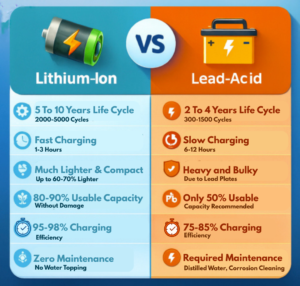
Lithium-ion batteries offer up to 5 times higher energy density, delivering more power with less weight and space.
Weight
Lithium-ion batteries are 60–70% lighter than lead-acid, making them ideal for portable or constrained-space applications.
Depth of Discharge (DoD)
- Lead-acid usable capacity: ≈ 50%
- Lithium-ion usable capacity: 80–95%
This means you get more usable energy from a lithium battery.
Cycle Life
- Lead-acid: 300–500 cycles
- Lithium-ion: 2000–5000 cycles
Lithium-ion lasts many years longer under daily usage.
Charging Speed
Lithium-ion batteries charge 2–3x faster due to higher charge acceptance.
Maintenance
- Lead-acid requires water topping, cleaning, and ventilation.
- Lithium-ion requires zero maintenance.
Performance Comparison
When evaluating Lithium-ion vs Lead-acid battery, overall performance is often the deciding factor.
| Feature | Lead-acid | Lithium-ion |
| Efficiency | 75–85% | 95–98% |
| Heat tolerance | Low | High |
| Backup duration | Short | Long |
| Voltage stability | Drops quickly | Very stable |
Cost Comparison: Upfront vs Lifetime
Upfront Cost
Lead-acid batteries are cheaper initially.
Lifetime Cost
Lithium-ion batteries last 4–8 times longer, making them more cost-effective in the long run.
Example Calculation:
- A ₹10,000 lead-acid battery replaced every 3 years = ₹30,000 in 9 years
- A ₹25,000 lithium battery lasting 8 years = cheaper long-term, fewer replacements, no maintenance
Thus, lithium-ion is the better value for daily use and long-term applications.
Lifespan & Maintenance
Lead-acid
- Needs frequent maintenance
- Sulfation shortens lifespan
- Sensitive to deep discharge
- Risk of corrosion and leaks
Lithium-ion
- Long, stable performance even with daily use
- Maintenance-free
- BMS protects from overcharge, over-discharge, and overheating
Lithium-ion batteries offer dramatically better long-term reliability.
Which Battery Should You Choose?
Choose Lead-acid if:
- Your budget is very limited
- You need basic or occasional backup
- You do not mind maintenance
- Heavy battery weight is not a concern
Choose Lithium-ion if:
- You want long-term savings
- You use solar or inverter systems daily
- You want zero maintenance
- You need fast charging and stable output
- You prefer a lightweight, compact solution
For modern home solar systems, inverter setups, and EVs-lithium-ion is the smarter choice.
Environmental Impact
Lithium-ion Batteries
- Longer lifespan = fewer replacements
- More energy-efficient
- Safe and clean operation
- Lower carbon footprint over time
Lead-acid Batteries
- Highly recyclable (up to 95%)
- Contains toxic lead and harmful chemicals
- Can cause soil and water pollution if not recycled properly
While both can be recycled, lithium-ion is generally more environmentally friendly during usage.
Conclusion
The Lithium-ion vs Lead-acid battery comparison clearly shows that lithium-ion batteries offer superior performance, long lifespan, higher efficiency, and better long-term cost savings. Lead-acid batteries still work for short-term or budget-limited uses, but they cannot compete with the technological advantages of lithium-ion.
If you’re planning to upgrade your solar system, inverter, or energy storage setup, lithium-ion is the best choice for the future.
 Previous Post
 Next Post