


A Comprehensive Guide to Different Types of Solar Panels: Choosing the Right One for Your Needs
Introduction: Types of Solar Panels in India
Types of solar panels in India have seen massive technological improvement over the last decade. With electricity prices rising every year and power supply still unreliable in many regions, solar energy has become more than just an alternative it is now a smart financial decision.
India receives abundant sunlight for nearly 300 days a year, making it one of the most suitable countries for solar power generation. From small residential rooftops to large industrial plants, solar installations are growing rapidly across urban and rural areas alike.
However, many people make the mistake of choosing a solar panel purely based on price. In reality, different solar panel technologies behave differently under Indian weather conditions such as extreme heat, heavy monsoons, dust, and humidity. This guide explains everything you need to know so you can invest confidently and avoid costly mistakes.
Why Choosing the Right Solar Panel Matters
India’s climate is demanding. High summer temperatures can reduce panel efficiency, dust accumulation can block sunlight, and monsoon humidity can impact long-term durability. Choosing the wrong solar panel can result in poor performance and delayed return on investment.
Selecting the right solar panel helps you:
- Generate maximum power even in high heat
- Reduce maintenance and cleaning costs
- Increase system lifespan
- Recover installation cost faster
- Qualify for government subsidies and net metering
A well-chosen solar panel is not an expense it is a long-term asset that delivers savings for 25 years or more.
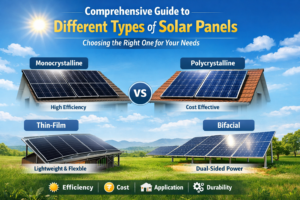
Monocrystalline Solar Panels
What Are They?
Monocrystalline solar panels are manufactured using a single, high-purity silicon crystal. This advanced manufacturing process results in uniform cells, usually dark black in colour, giving them a premium appearance.
Why They Perform Better in India
Monocrystalline panels are highly efficient and handle high temperatures better than most other technologies. This makes them particularly suitable for Indian cities where rooftop space is limited and summer temperatures are extreme.
Pros:
- Highest efficiency (20–24%)
- Requires less rooftop space
- Excellent performance in hot climates
- Long lifespan of 25–30 years
Cons:
- Higher upfront cost compared to other types
Best For:
- Residential rooftops
- Urban homes and apartments
- High electricity consumption households
Polycrystalline Solar Panels
What Are They?
Polycrystalline solar panels are made from multiple silicon fragments fused together. Their manufacturing process is simpler, making them more affordable for Indian consumers.
Performance in Indian Conditions
These panels work well in moderate climates and are widely used across India due to their cost-effectiveness. However, they require slightly more space to produce the same amount of power as monocrystalline panels.
Pros:
- Affordable and budget-friendly
- Decent efficiency (15–18%)
- Easy availability across India
Cons:
- Lower efficiency in extreme heat
- Requires larger rooftop area
Best For:
- Independent houses with larger rooftops
- Budget-conscious homeowners
- Rural and semi-urban installations
Thin-Film Solar Panels
What Are They?
Thin-film solar panels are created by layering photovoltaic materials onto glass, metal, or plastic surfaces. Unlike traditional panels, they are lightweight and flexible.
Use Case in India
Thin-film panels perform better in shaded or low-light environments but produce less power overall. Due to their lower efficiency, they are rarely used for residential rooftops.
Pros:
- Lightweight and flexible
- Better performance in diffused sunlight
- Easy to install on curved or large surfaces
Cons:
- Low efficiency (10–13%)
- Shorter lifespan
- Requires more space
Best For:
- Industrial sheds
- Warehouses
- Temporary or portable solar setups
Bifacial Solar Panels
What Are They?
Bifacial solar panels generate electricity from both the front and rear sides by capturing reflected sunlight from surfaces like concrete, sand, or white rooftops.
Why They’re Growing in India
With large open spaces available in solar parks and industrial zones, bifacial panels are becoming popular for utility-scale projects.
Pros:
- Higher overall energy output
- Excellent long-term returns
- Durable glass-glass design
Cons:
- Higher installation cost
- Needs reflective surface for best results
Best For:
- Solar farms
- Commercial and industrial projects
Which Solar Panel Is Best for Indian Conditions?
For most Indian households, monocrystalline solar panels provide the best balance of efficiency, durability, and long-term savings. If budget is limited and space is not an issue, polycrystalline panels remain a dependable option.
Thin-film and bifacial panels are best reserved for industrial or large-scale installations rather than standard home rooftops.
Cost Comparison of Solar Panels in India
Solar Panel Type
Monocrystalline
Polycrystalline
Thin-Film
Bifacial
Average Cost per kW (₹)
₹55,000 – ₹70,000
₹45,000 – ₹60,000
₹40,000 – ₹55,000
₹65,000 – ₹80,000
- Prices may vary based on city, brand, inverter type, and mounting structure.
Government Policies & Subsidies in India
The Government of India actively promotes rooftop solar through subsidies and net metering policies, reducing the overall system cost for consumers.
Subsidies are mainly available for:
- Residential rooftop solar systems
- Grid-connected solar installation
Final Verdict: Choosing the Right Solar Panel
Understanding the types of solar panels in India allows you to make a confident and future-proof decision. The best solar panel is the one that matches your space, budget, and energy needs not just the cheapest option available.
Quick Recommendation
- Small rooftop → Monocrystalline
- Budget-focused system → Polycrystalline
- Industrial use → Thin-film or Bifacial
Solar power is no longer optional it is a smart step toward energy independence and long-term savings.
 Next Post